문의하기
CEN 실행
Computer vision has historically been built around the image. For more than a decade, progress in the field was driven by better image datasets, better annotation practices, stronger convolutional backbones, more capable transformers, and increasingly sophisticated ways to interpret pixels. This evolution brought major advances in detection, segmentation, classification, tracking, and multimodal reasoning. However, as AI systems move from benchmark environments into physical and operational spaces, the limits of purely image-centric thinking are becoming more apparent. Many real-world tasks require more than recognizing what appears in a frame. They require understanding how a scene exists in space.
This shift is one reason NeRF, or Neural Radiance Fields, has gained so much attention. NeRF introduced a different way of representing visual scenes. Rather than storing only a set of images or a manually built geometric model, it learns a continuous volumetric representation of a scene from multiple views. That representation can then be rendered from novel camera positions, often with impressive photorealism and viewpoint consistency. This is a meaningful step because it changes the relationship between captured reality and machine perception. A scene is no longer just a collection of snapshots. It becomes something that can be re-explored from many perspectives.
For vision AI, this opens a new design space. Traditional datasets are limited by how they were captured. If an environment was recorded from a fixed number of camera angles, then the training set reflects those angles and little else. If a team later needs different viewpoints, better occlusion behavior, or more scene variation, they often need to recollect data or build costly simulations from scratch. NeRF-based rendering offers a more flexible middle ground. It allows organizations to reconstruct environments from observed imagery and then generate additional views with spatial coherence. This increases the usable value of captured scenes and turns them into reusable visual assets rather than one-time recordings.
The implications are especially important for industries where camera position, environmental structure, and line of sight matter. Robotics, autonomous navigation, industrial inspection, infrastructure monitoring, construction technology, mapping, drones, digital twins, and smart facilities all involve environments where spatial understanding is critical. In these contexts, an AI system may need to reason not only about object appearance, but about perspective shifts, geometry, depth relationships, occlusion patterns, and scene continuity. A purely 2D dataset can support some of this, but only indirectly. NeRF offers a representation that is much closer to how these environments must actually be understood.
This has significant consequences for data generation. In many real-world projects, collecting enough imagery from enough viewpoints is expensive and operationally burdensome. Some locations are difficult to access. Some conditions are hard to repeat. Some environments change faster than teams can rescan them. Some inspections require specific angles that are not always available during capture. A NeRF-based workflow can help relieve some of that pressure by allowing a scene to be reconstructed once and then explored in more flexible ways. While it does not eliminate the need for real capture, it increases the downstream utility of every capture session.
NeRF is also relevant because it changes how realism can be integrated into synthetic data workflows. Many synthetic data pipelines rely on manually built 3D assets and physically based rendering systems. These approaches offer strong control and are often highly effective, but they may require significant modeling effort and can struggle to reproduce the richness of real visual environments at scale. NeRF introduces a complementary possibility: starting not from pure simulation, but from captured reality that has been converted into a reusable scene representation. This makes it possible to blend realism, viewpoint flexibility, and scalable data reuse in a way that sits between raw photography and fully manual 3D authoring.
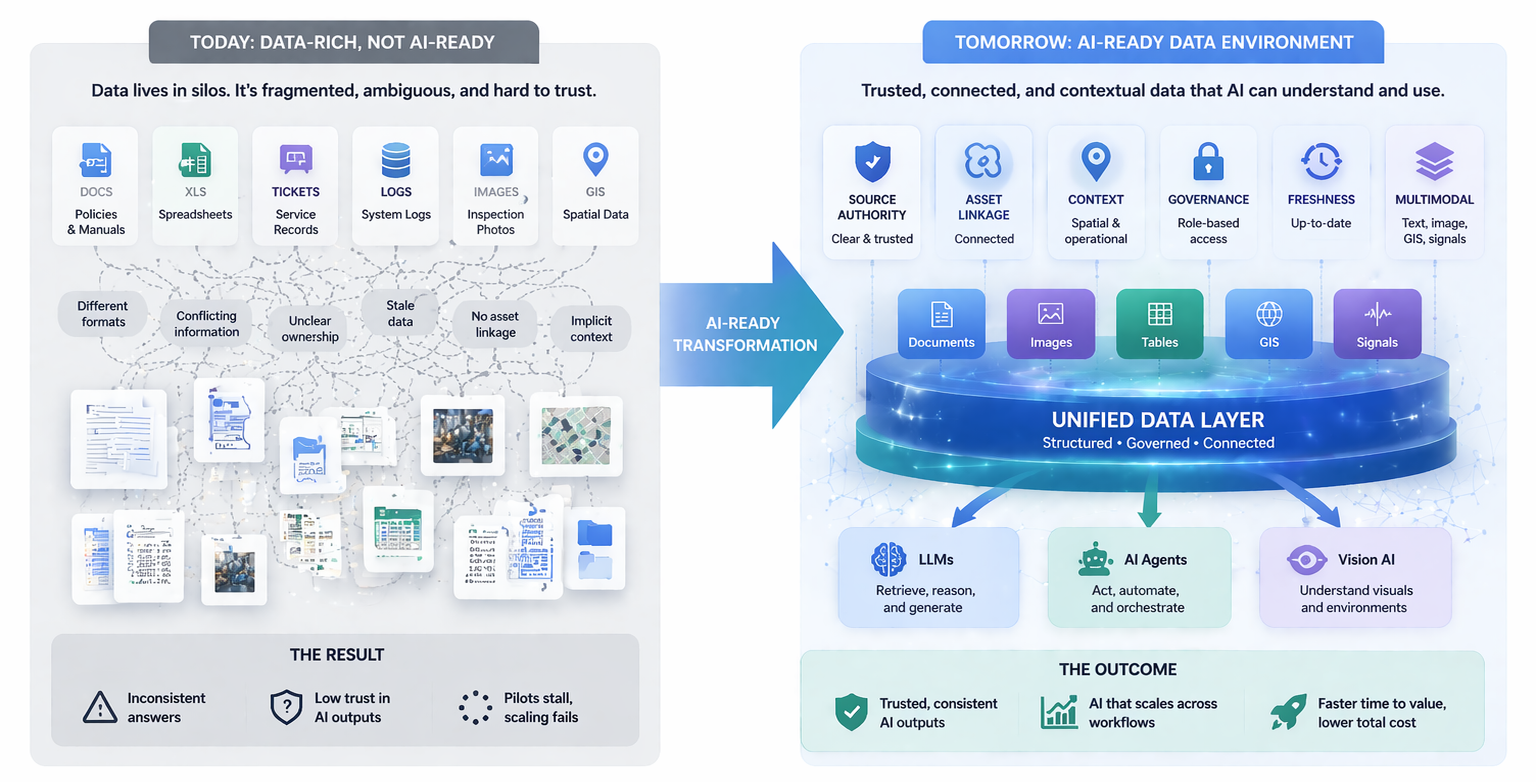
Another reason NeRF is reshaping vision AI is that it supports the broader movement from frame-based understanding to scene-based intelligence. Many emerging AI systems are expected to interact with spaces, not just images. They must navigate, inspect, simulate, estimate, compare, predict, and respond in environments where geometry and physical continuity matter. In such settings, the data representation itself becomes important. A model trained only on disconnected image samples may struggle to generalize across movement, spatial context, or multi-view consistency. A scene-based representation offers richer structural grounding.
This becomes particularly valuable when combined with digital twin strategies. Digital twins are not just visual replicas. They are operational environments where spatial, semantic, and sometimes physical properties can be modeled, updated, and used for analysis. NeRF can strengthen this ecosystem by helping convert real environments into reusable, navigable visual representations with lower friction than traditional manual reconstruction alone. In a digital twin pipeline, this can support inspection, simulation, planning, visualization, and AI training workflows that depend on an environment being represented as a coherent whole.
There is also a practical data advantage here. Vision models often fail because they have not seen enough meaningful variation in viewpoint, scale, occlusion, or environmental arrangement. NeRF-based scene rendering helps expand variation while keeping the environment anchored in real capture. This is valuable for tasks such as object recognition from nonstandard angles, infrastructure inspection across large sites, drone-based scene understanding, warehouse monitoring, industrial spatial reasoning, and immersive AI-supported visualization. Instead of treating every new perspective as a separate data collection problem, teams can derive additional perspective coverage from the same reconstructed scene.
Of course, NeRF is not a universal solution. It has limitations in dynamic environments, moving objects, heavy computational requirements, and production constraints related to rendering speed and scene complexity. It may not replace conventional 3D pipelines, sensor-specific simulation stacks, or real-time operational systems in all cases. But its significance does not depend on replacing everything else. Its importance lies in expanding what is possible. It provides a bridge between raw image capture and scene-aware machine perception. It gives organizations a new way to think about how environments can be represented, reused, and translated into AI training value.
This matters strategically because vision AI is evolving toward more embodied and operational use cases. The next wave of applications will demand not only high classification accuracy, but stronger spatial reasoning, more adaptive navigation, more robust environmental understanding, and better integration with physical systems. AI will increasingly need to interpret environments as structured spaces rather than flat visual inputs. In that transition, representations like NeRF are likely to become more important, not less.
It is also worth noting that NeRF changes the economics of visual data in subtle but meaningful ways. If captured scenes can be reconstructed into reusable spatial assets, then the marginal value of each capture effort increases. A site survey, an environment scan, or a multi-view imaging sequence becomes more than archived reference material. It becomes part of an expandable data foundation that can support simulation, inspection, visualization, and model development over time. That kind of reusability is highly attractive in industrial and enterprise settings where data collection is expensive and repeated capture cycles are difficult to justify.
Ultimately, NeRF-based rendering is reshaping vision AI because it pushes the field toward richer scene understanding. It supports new training workflows, creates more reusable visual assets, enables broader viewpoint coverage, and strengthens the connection between real environments and synthetic or semi-synthetic data generation. It does not diminish the value of traditional image datasets or conventional simulation. Instead, it extends the toolbox and creates a more continuous path between captured reality, spatial reconstruction, and AI development.
That is how NeRF-based 3D environment rendering is reshaping vision AI. It represents a move away from treating visual data as isolated frames and toward treating environments as explorable, structured, and reusable spaces. As more AI systems are asked to operate in the real world rather than simply observe it, that transition will become increasingly important.