For years, enterprise data strategy was largely built around structured records and text-heavy repositories. Organizations invested in databases, dashboards, data lakes, document systems, and analytics pipelines designed to manage information in tabular or textual form. Even when AI adoption began to accelerate, many companies still approached machine intelligence through this same lens. They focused on text classification, document search, summarization, forecasting, and other tasks that fit comfortably into existing data infrastructure. But the rise of multimodal AI is changing that assumption.
Multimodal AI is not simply an incremental improvement to language models. It represents a deeper shift in how machines interact with the world. Instead of processing text alone, modern systems are increasingly able to reason across images, video, speech, sensor streams, spatial context, and structured knowledge at the same time. That expansion matters because real business environments are not made of text alone. Factories generate visual signals, logistics systems depend on camera feeds and geospatial information, customer service combines voice and text, healthcare workflows involve scans and reports together, and industrial environments often require correlating imagery, location, telemetry, and operational logs. As soon as AI becomes multimodal, the enterprise data market must become multimodal as well.
This shift is creating a new definition of valuable data. Historically, many organizations treated non-textual assets as peripheral or secondary. Images were stored for recordkeeping. Video was archived for compliance or monitoring. Spatial information was used only by specialized teams. Audio was rarely integrated into core data strategy. Under a multimodal AI paradigm, these assets become much more central. They are no longer passive byproducts of operations. They become training material, evaluation material, context signals, and decision-support inputs for next-generation AI systems.
That transformation has major implications for enterprise infrastructure. Companies can no longer assume that being "data-rich" in the traditional sense means they are AI-ready. An organization may have millions of documents and years of historical records, but still be underprepared if its visual, spatial, and sensor data is fragmented, unlabeled, inaccessible, or operationally unusable. In other words, multimodal AI is not just creating new model capabilities. It is exposing hidden weaknesses in how enterprises collect, organize, and govern information beyond text.
This is one reason the enterprise data market is changing so quickly. Demand is moving away from simple storage and toward orchestration. Businesses increasingly need systems that can align images with metadata, video with event logs, documents with diagrams, telemetry with spatial context, and simulation data with real-world capture. The challenge is no longer just storing data in separate systems. It is building relationships between different data types so that AI systems can learn from them together. That is a much more demanding task than traditional data warehousing.
From a commercial perspective, this creates room for entirely new categories of infrastructure and services. Data platforms must support multimodal ingestion, transformation, indexing, and retrieval. Labeling systems must expand beyond text annotation into image segmentation, scene understanding, temporal event mapping, and cross-modal linking. Synthetic data systems must move from isolated image generation toward richer pipelines that produce visual, semantic, and structural consistency across multiple data forms. Evaluation systems must become more sophisticated because success can no longer be measured by text-only benchmarks.
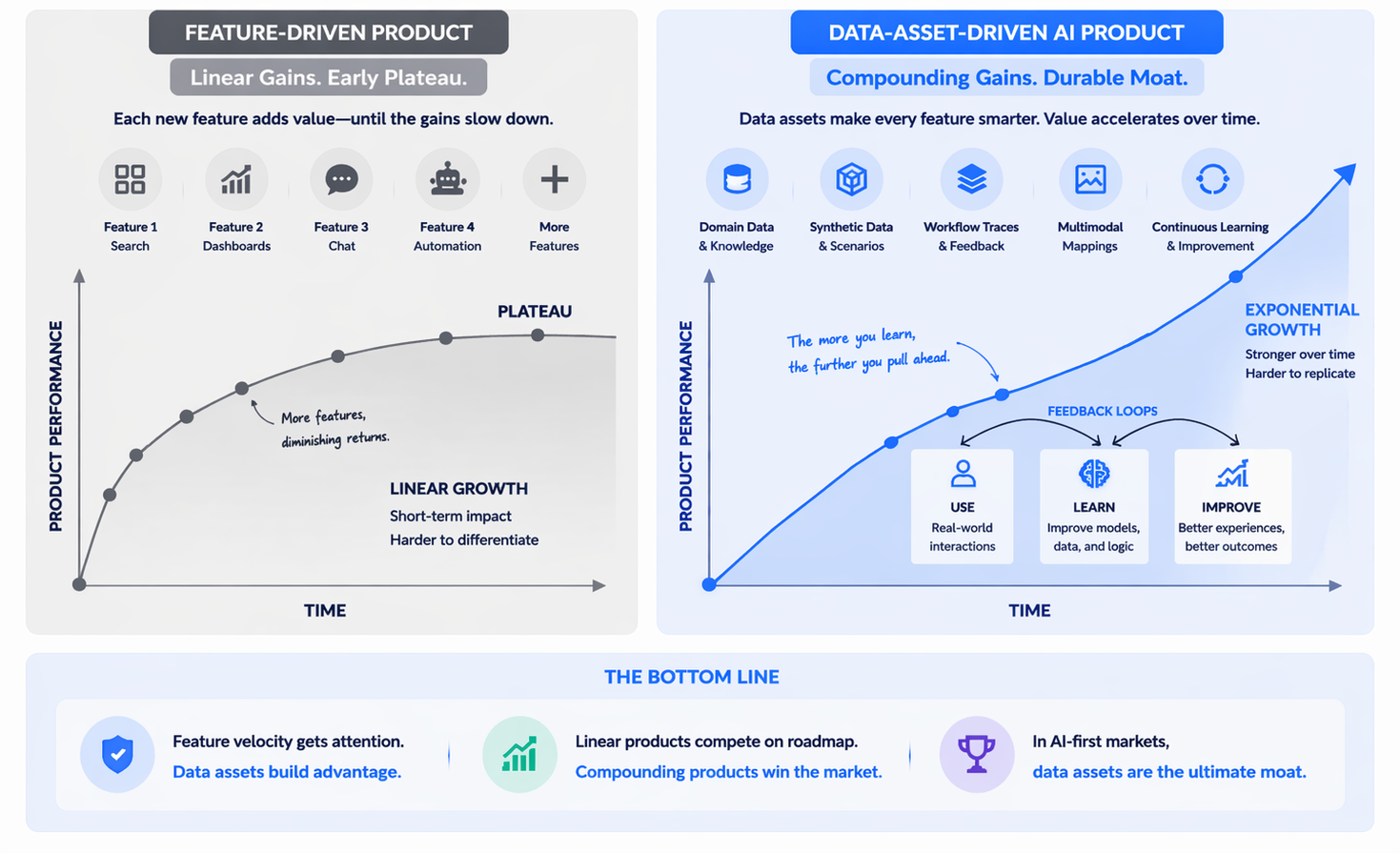
Another major consequence is that multimodal AI increases the importance of domain-specific data design. General-purpose internet data may still be useful for pretraining broad capabilities, but enterprise value increasingly comes from data that reflects the exact operating environment of the business. A warehouse AI system does not only need text-based SOPs. It may need camera footage, object placement data, layout maps, inventory flows, worker behavior patterns, and exception scenarios. A smart manufacturing system may need machine telemetry, defect imagery, maintenance logs, environmental conditions, and spatial relationships between equipment. A multimodal enterprise model becomes valuable only when these different layers are aligned.
This is where synthetic data and simulation become increasingly strategic. Real multimodal data is difficult to collect at scale in a consistent and compliant way. Video may be sensitive. Sensor logs may be incomplete. Spatial information may be difficult to standardize. Certain rare events may almost never occur in recorded data. Synthetic and simulation-driven pipelines can help fill these gaps by generating controllable data combinations that reflect operational needs. Instead of waiting for reality to produce enough examples, enterprises can design multimodal scenarios deliberately.
Multimodal AI also changes the economics of data preparation. In a text-only environment, organizations might still believe they can move forward with partial curation and ad hoc data cleanup. In a multimodal environment, weak data architecture becomes much more expensive. Misaligned timestamps, poor metadata standards, disconnected asset repositories, inconsistent labels, and incomplete context chains all reduce model reliability. A multimodal system is only as strong as the relationships between its data types. If the data ecosystem is fragmented, the intelligence layer becomes fragile.
This is why the rise of multimodal AI is pushing enterprises to rethink the market itself. Data is no longer just content to be stored or analyzed. It is becoming a cross-modal asset network that must be structured for machine interpretation. The companies that benefit most from this shift will not necessarily be those with the largest raw data volumes. They will be those that understand how to connect visual, textual, spatial, and operational signals into coherent AI-ready foundations.
There is also a governance dimension here. As more data types enter AI workflows, the complexity of privacy, compliance, ownership, and access control increases. Images may contain identities or physical layouts. Audio may contain sensitive speech. Video may reveal operations, behavior patterns, or restricted environments. Geospatial data may expose critical infrastructure or internal movement patterns. Multimodal AI therefore forces enterprises to think more carefully about what can be used, how it should be transformed, and which forms of access are appropriate across teams and systems.
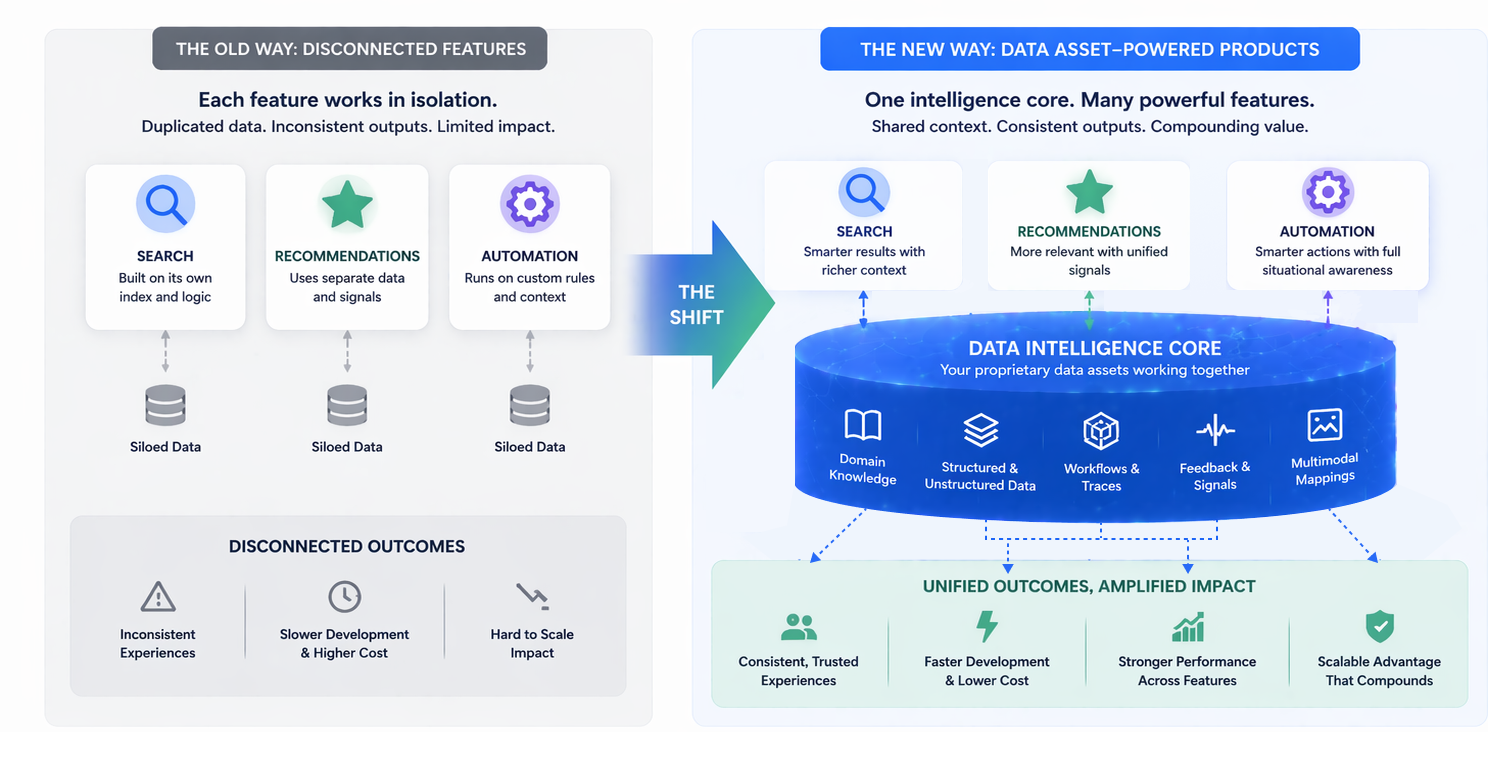
Ultimately, multimodal AI is reshaping the enterprise data market because it is redefining what enterprise intelligence requires. AI is moving closer to the real operating world, and the real operating world is multimodal by nature. Companies that continue to treat text as the only serious data layer will increasingly find themselves constrained. Those that invest in multimodal data architecture, synthetic augmentation, cross-modal alignment, and governance-aware infrastructure will be in a much stronger position to build useful and defensible AI systems.
That is how the rise of multimodal AI is reshaping the enterprise data market. It is not simply adding new data types to existing pipelines. It is changing the very structure of what an AI-capable enterprise data strategy must look like.
